
The Evidentiary Shield: Why EU Directive 2023/970 is a Balance Sheet Liability, Not an HR Exercise
- Mar 20
- 2 min read
Updated: Apr 3
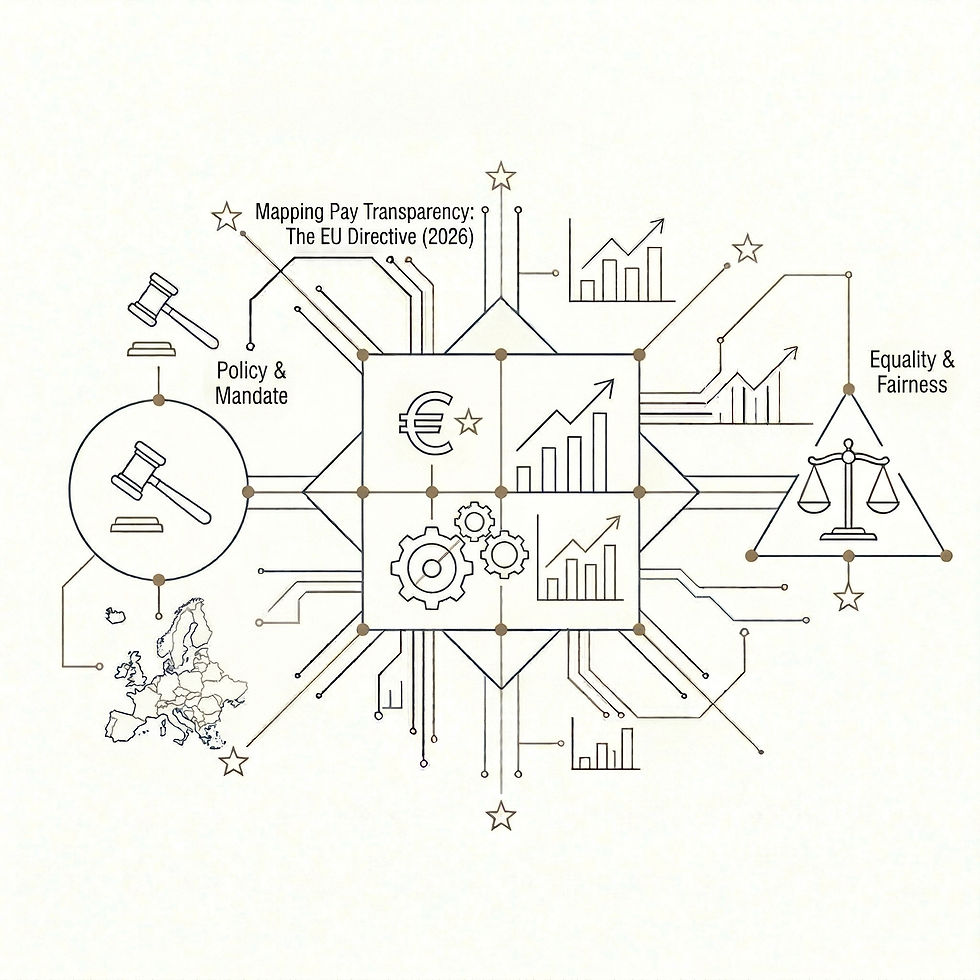
There are fewer than 80 days remaining until the transposition deadline for the EU Pay Transparency Directive (June 7, 2026).
We observe a standard market tendency to delegate the calibration of the new salary grids to Human Resources departments. Internal HR tools will rightfully manage retention and administrative compliance.
However, from a strict balance sheet risk perspective, this delegation leaves a severe, unmitigated legal exposure at the Board level.
Last week, during a confidential advisory session with the CFO of a regional manufacturing group, it became clear that this specific transversal risk was absent from their 2026 Board agenda.
1. The Burden of Proof (Art. 18) and Uncapped Damages (Art. 16)
Once Article 18 is activated, the "burden of proof" in pay-related litigation shifts entirely to the employer.
What happens when a strategic decision to freeze a salary (managing "Red Circle" anomalies) is challenged in a Romanian court?
How will the company mathematically demonstrate compliance across the four pillars mandated by law (Article 4)?
Skills
Effort
Responsibility
Working conditions
In the absence of an independent evidentiary baseline, a contested management decision exposes the company to uncapped financial damages (Article 16). This is a direct threat to the P&L.
2. Fiduciary Rigor: The Finance Department and Group Contagion (Art. 19)
The expertise of C Level Finance is strictly delineated: we architect this Evidentiary Shield exclusively for the CFO's ecosystem.
We do not evaluate Operations, Sales, or IT. We secure the finance department, from the execution level to strategic leadership.
For Group structures, Holdings, and Private Equity portfolio companies, the risk becomes transversal.
Under Article 19 (Single Source), litigation can cross subsidiary borders. The existence of separate legal entities (different tax registration numbers/CUIs) no longer functions as a protective corporate veil if remuneration policies are dictated centrally.
Therefore, to neutralize the risk of legal contagion, our audit must transversally cover the entire group architecture.
3. Diagnosis and Exposure Governance: The Fiduciary Risk Audit
Prudent Boards do not leave this balance sheet liability uncovered.
The fiduciary compliance of these grids is no longer an administrative checkbox.
The capital cost of transposing this directive must be mathematically modeled before signing off on 2026 budgets.
At C Level Finance, we operate exclusively under a model of total transparency (Fixed-Fee structure), completely decoupling our interests from the inflationary wave of gross salaries.
We deploy Phase 1: The Fiduciary Risk Audit. In a 5-day operational sprint, we algorithmically map internal structural vulnerabilities against ILO (International Labour Organization) standards, operating entirely within our secure Zoho ecosystem.
The deliverable is the Fiduciary Risk Heatmap—the precise clinical instrument the CFO requires to mathematically anchor decisions before the activation of Article 18.
Conclusion: Board-Level Security
Your perspective is critical for the governance of this exposure.


